Taha Maknoo

After Google's big update in March 2024, hundreds of websites disappeared from search overnight.
People looked at the sites that got hit. Almost all of them used AI to write their content. So it is easy to think one thing: Google must punish AI content.
But that is the wrong lesson. And believing it can hurt you. Google does not punish content just because AI wrote it. It punishes content that is thin, copied, or made only to rank.
That is what most of those AI sites were doing.
If you want the short answer,
No, Google does not punish content just for being made by AI. However, it penalizes content that is unhelpful, copied, or built only to trick search rankings, no matter who or what made it. AI is not the problem. Weak content is.
This guide explains the whole thing in plain English. What Google's rules really say and the simple steps you can take to stay safe, whether you write by hand or with AI.
What Google actually says - in its own words
Google has published its position in several places, and it has been remarkably consistent since 2023.
Start with the canonical source: Google's February 2023 guidance on AI-generated content, written by Search liaison Danny Sullivan and the Search Quality team's Chris Nelson.
It states plainly that appropriate use of AI or automation is not against Google's guidelines. The line it draws is about purpose:
Using automation, including AI, to generate content with the primary purpose of manipulating ranking is a violation of our spam policies. – Google Search Central, guidance on AI-generated content.
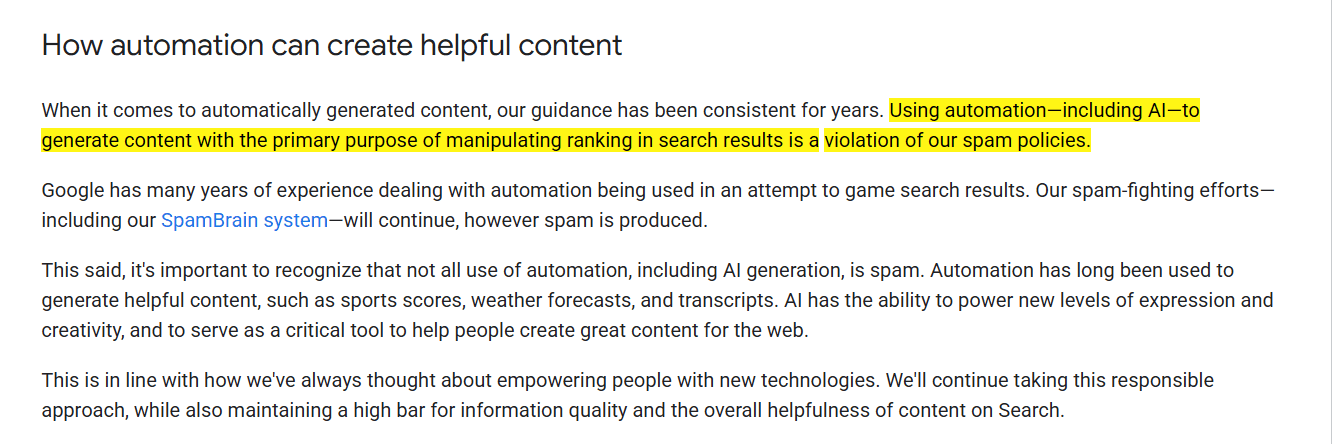
Two things follow from this statement.
Google's spam-fighting systems, including its machine-learning system SpamBrain, keep working regardless of how the spam was produced.
Not all automation is spam. Google itself notes that automation has long generated genuinely useful content: sports scores, weather forecasts, and transcripts are all automated and all helpful. The technology was never the dividing line.
So how does Google evaluate any given page, AI-assisted or not? Its help documentation points creators to three questions, the "Who, How, and Why" test:
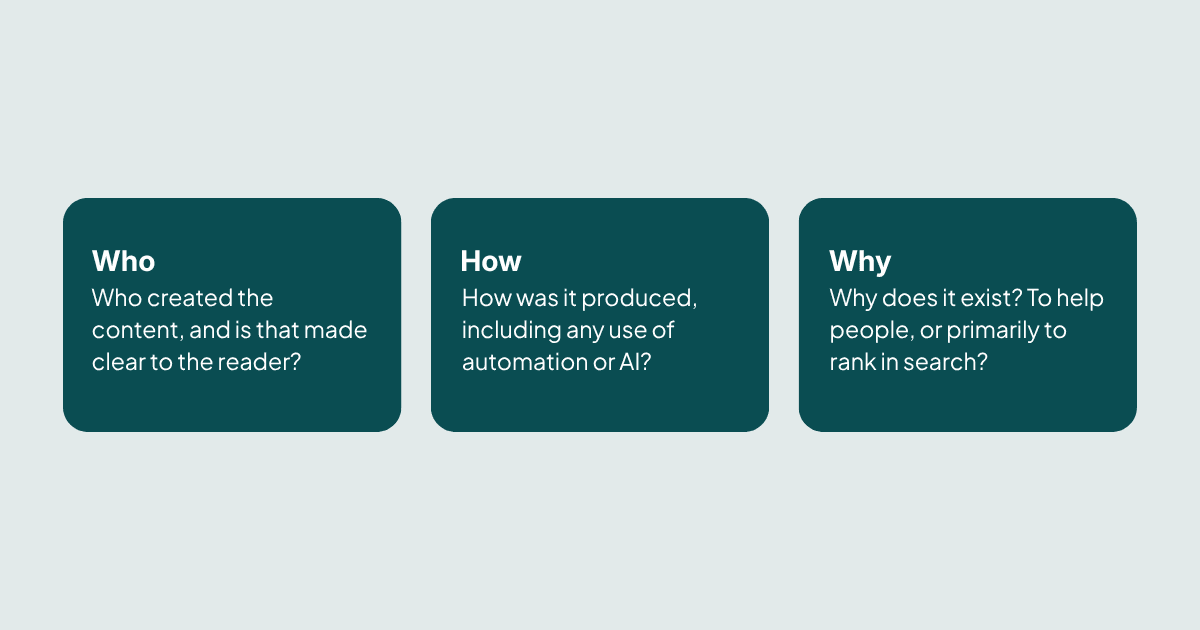
Who: Who created the content, and is that made clear to the reader?
How: How was it produced, including any use of automation or AI?
Why: Why does it exist? To help people, or primarily to rank in search?
Google's documentation on generative AI content adds a practical recommendation: when automation plays a meaningful role, consider telling readers how the content was made, in whatever way suits your audience.
It also flags that Your Money or Your Life topics, anything touching health, finance, or safety, are held to a higher bar.
The consistent message across all of it, from the spam policies to the helpful-content guidance to the Search Quality Rater Guidelines, is one idea: quality and purpose decide, and production method does not.
What Google actually says - in its own words
Google's crackdown on low-value content did not begin with AI. It began with a signal called the Helpful Content System.

The Helpful Content Update first arrived in August 2022 as a site-wide signal designed to reward people-first content and demote pages built mainly to rank. Google refined it through 2022 and 2023.
Then came the pivotal moment: the March 2024 core update, which Google's Chris Nelson described as more complex than a usual core update and, in his words, "an evolution in how we identify the helpfulness of content."
That update folded the Helpful Content System directly into Google's core ranking systems, ending standalone helpful-content updates and baking quality assessment permanently into the algorithm.
Alongside it, Google launched three new spam policies aimed squarely at the tactics low-value publishers relied on:
Spam policy | What it targets |
Scaled content abuse | Producing many pages primarily to manipulate rankings, with little value to users, however they are made |
Site reputation abuse | Publishing low-value third-party pages on a trusted host to exploit its ranking signals, often called parasite SEO |
Expired domain abuse | Buying expired domains to reuse their existing authority for unrelated, low-value content |
Google initially projected the combined effort would reduce low-quality, unoriginal content in results by 40%.
When the rollout finished, it revised that upward: a spokesperson said the work delivered closer to a 45% reduction, better than expected.
Site reputation abuse enforcement was given a grace period and began on May 5, 2024.
Through 2025, further spam updates in February, June, and August continued the pressure.
Google wiped out a bunch of AI sites.
The pattern across four years is unmistakable. Google built a durable, always-on quality system, then wrapped explicit spam policies around the specific ways people were gaming it.
Nothing in that timeline penalizes AI as such. It penalizes low-value content at scale, which is simply what a lot of AI content turned out to be.
So why did all those AI sites get wiped out?
If AI is not the problem, why did the March 2024 update read like a massacre of AI sites?
Because the update targeted low-quality, unoriginal content, and an enormous share of that content happened to be careless AI output.
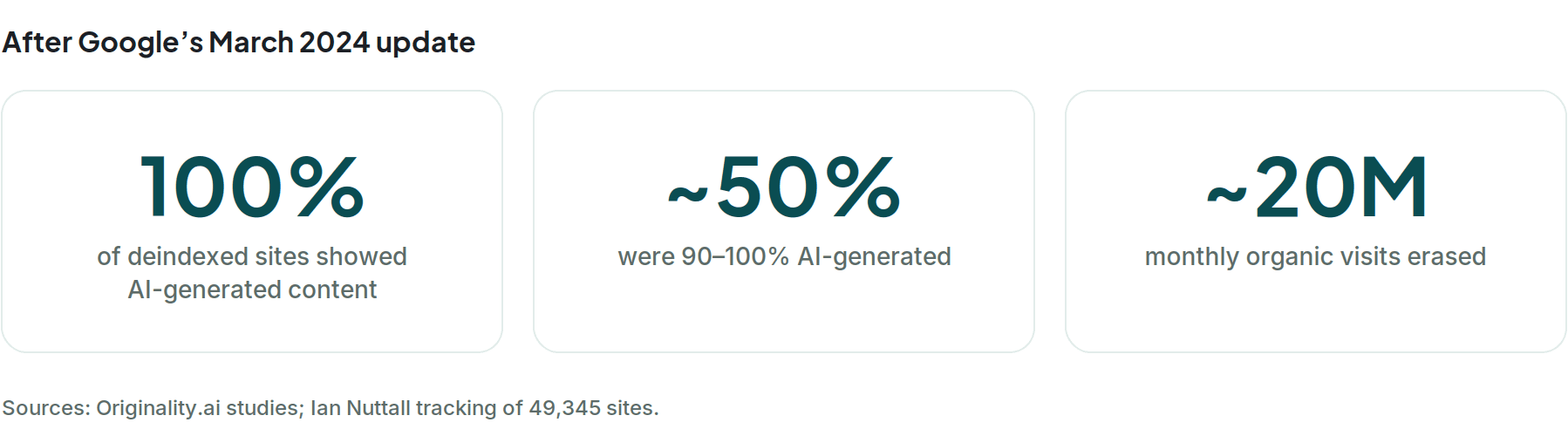
Two studies by Originality.ai examined the sites hit with manual actions after the update.
In one sample of roughly 79,000 sites, about 1.8% received manual actions. Across the penalized sites, 100% carried AI-generated content, and about half were 90 to 100 percent AI.
Separately, the SEO analyst Ian Nuttall tracked 49,345 sites and found 837 (about 1.7%) fully deindexed, wiping out an estimated 20 million monthly organic visits and, by one estimate, hundreds of thousands of dollars in monthly ad revenue.
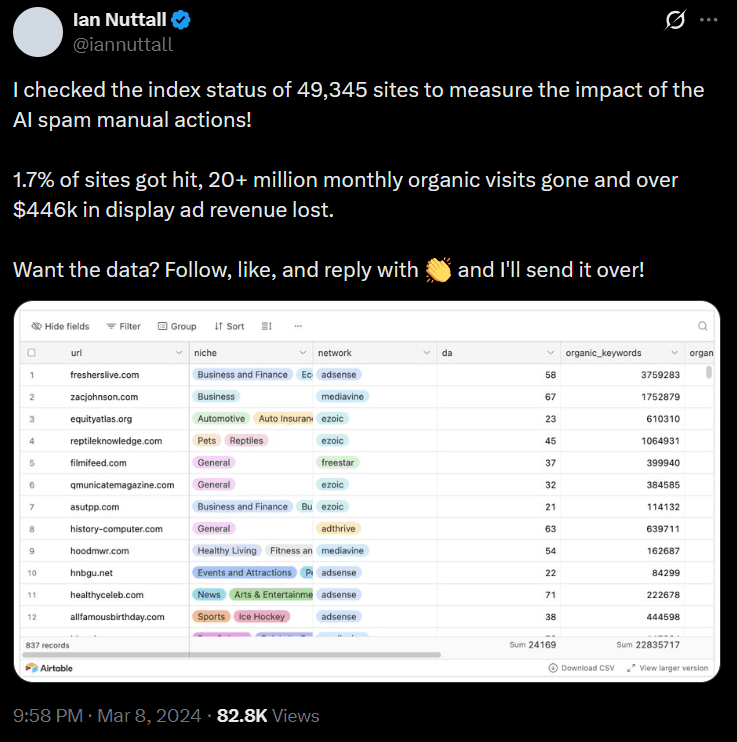
These sites were punished for using AI to flood the web with hundreds or thousands of near-identical, low-effort pages built to rank rather than to help.
It is also worth noting that identifying AI content with certainty is genuinely hard, even for specialist tools, which is exactly why Google says it does not rely on an AI detector as a ranking signal. It evaluates helpfulness and originality, and low-value AI content fails those tests on its own.
What kind of content gets ranked - and what gets penalized?
There’s no human vs AI filter that your content needs to use.
The line Google actually draws runs between content that serves a reader and content that serves a ranking.
To be precise, here are all the differences:
Content that ranks fine | Content that gets penalized |
Content includes original data, insight, or first-hand experience on every page. | Content that provides no new information, opinion, or contribution. It is recycled content that others have already written. |
This kind of content aims to answer a real search someone actually makes. | Content that is produced with no depth. It seems like the content is written by robots, for robots. Even you wouldn’t want to read it twice. |
Fact-checked, especially on health, money, and safety. | Includes irrelevant information and fillers that don’t serve any value to readers. Even your own data seems like stolen screenshots. |
Published in measured batches. | Hundreds of pages dumped overnight. |
Honest about who made it and how. | Hidden behind fake authors and third-party domains. |
The silver lining: “AI content is everywhere. The winners just use it well”
AI isn’t going anywhere, and frankly most companies looking to make it through the next 5 years need to adopt AI.
Be it in content, workflow, ads, operations, sales, or HR, your company will have to adopt AI in one form or the other.
You do not have to be afraid of AI. It is already normal. By late 2023, close to half of the biggest publishers were already using AI in some way.
And Google is fine with it. The sites that win are not the ones that avoid AI. They are the ones that use it well.
The trick is simple. Use AI as a helper, not a replacement. Let it do the boring, slow parts. Then add the human touch that makes content real.
You do not need a big team or a developer to do this well. The right tool can handle the heavy lifting and keep you inside Google's rules at the same time. That is the whole reason we built GroGoliath.
Things you can do today
You do not need to be an expert to stay on the safe side. Here is a short checklist. If you can tick these boxes, you are already ahead of most people.
Combine AI with human expertise: Always have a subject-matter expert review and refine AI drafts to add unique industry insights and ensure accuracy.
Focus on original value: Do not just regurgitate what is already online; add proprietary data, real-world examples, or fresh perspectives to your pages.
Leverage programmatic SEO responsibly: Use automated tools to scale high-quality, data-driven landing pages and blogs efficiently, ensuring each page delivers genuine value rather than thin duplicates.
Prioritize user intent: Ensure every piece of content directly answers what your audience is searching for, rather than stuffing keywords.
Keep your data accurate: Fact-check every statistic, claim, and source generated by AI before hitting publish.
Maintain a consistent brand voice: Edit the output so it sounds authentically like your business, building trust with your readers.
Regularly update your content: Keep your automated and AI-assisted pages fresh by reviewing performance and updating information over time.
Scaling your site (and business) the simpler way
Everything above is easy when you have just a few pages. It gets hard fast when you want hundreds.
Checking each page by hand, adding real data to each one, keeping them all different: that is where most people give up, or cut corners and get hit.
This is the exact problem we built GroGoliath to solve.
GroGoliath creates pages in bulk, but it fills each one with real data, keeps every page different, and holds a quick review step so a human signs off before anything goes live.
We built GroGoliath as a programmatic SEO tool that allows businesses of both small and large sizes to create pages in bulk. It allows businesses to create landing pages and blog posts in bulk in the right way.
In other words, it does the safe checklist for you, at a size no team could manage by hand. If you want to go deeper on building lots of pages the safe way, read our complete guide to programmatic SEO next.

Taha Maknoo
Content & SEO Strategist
Taha Maknoo is a content strategist and SEO specialist who writes about programmatic SEO, content operations, and scaling organic growth. He helps businesses build systems that turn thousands of pages into durable search traffic.
Start generating landing pages and blog posts at scale
