Taha Maknoo

Open an AI chat and ask it for the best project-management tool for a small design team. In seconds you get a clean shortlist, with reasons for each pick. Notice what did not happen.
You never saw a page of ten blue links.
You never clicked a website.
And for a fast-growing share of software buyers, that is now the whole journey.
The search box still exists. But the click that used to follow it is quietly disappearing.
For most SaaS teams, SEO has always meant one thing: rank number one, win the click, count the signups. That playbook is running out of road. But here is the good news, and it is real: the pages that win the new game are the same pages that always converted best. You were probably just too busy writing blog posts to build them.
Clicks are quietly dying
Look at what a search results page actually does now, because it has changed more in two years than in the previous ten.
More than half of Google searches in the US end without anyone clicking through to a website.
People read the answer and move on. For software buyers it is sharper still: an AI-written summary sits on top of the results for roughly eight out of ten business-software searches. Your future customer reads that summary first. Often, it is all they read.
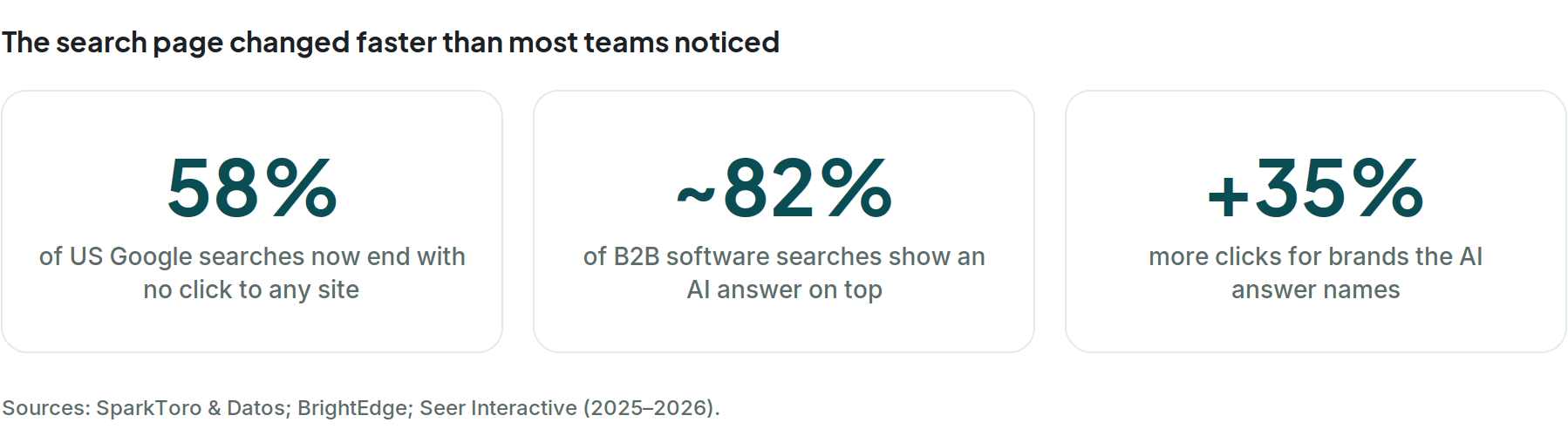
It is tempting to read those numbers as a funeral. It is not. Look at the last one again.
When the AI answer names a brand, that brand gets more clicks, not fewer. The traffic did not vanish. It moved. It now flows to whoever the answer is built from. So the job changed. For a decade, SaaS SEO was about being the link someone clicks. Now it is about being the source the answer is built from.
The old goal was to win the click. The new goal is to be the thing the answer is made of.

Machines don't fall for marketing
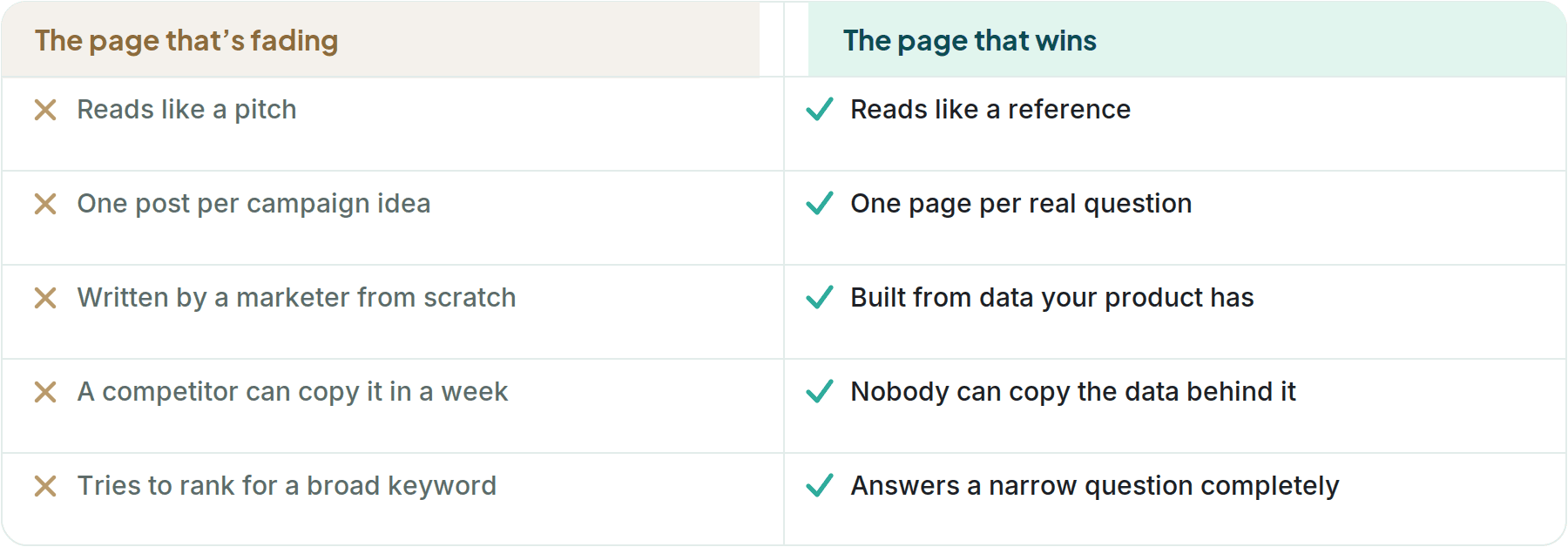
Think about what an AI answer is doing. It reads a lot of pages, throws out the fluff, and stitches together the few facts it trusts. It has no patience for a clever headline. It wants something specific and checkable. So ask yourself an honest question. If a machine had to build an answer about your product, which of your pages would it pull from? Your post titled “7 tips for happier teams”? Or a plain page that lists exactly which tools you connect to, what each integration does, and what it costs?
It picks the second one every time. And so does a human buyer, by the way. They always did. Think about how you shop for a specific bolt at a hardware store. You do not read the store’s blog about the joy of home improvement. You walk to the aisle, find the exact size, check the price, and leave. The pages that win in SaaS are aisles, not essays. They answer one specific question and get out of the way.
Your product is your best writer
Here is the shift most teams miss, so let me say it plainly. Great SaaS SEO is not a content problem. It is a product problem.
The clearest proof is Zapier. It did not out-blog anyone. It took its list of app connections and turned it into a page for every app and every pairing, thousands of them, each answering one question: how do I connect this tool to that one. Those pages, built straight from product data, drive a large share of its search traffic (Ahrefs documented this in its Zapier case study). You see the same move wherever a company turned its own data into pages: Wise built pages for currency conversions and bank codes, Canva for its template library, G2 for software reviews. None of these are marketing essays. They are the product, turned into pages.
That is the real moat. A rival can copy your blog’s tone in an afternoon. A rival cannot copy the data only you have: your integrations, your templates, your pricing, your real usage. Turn that data into pages and you build something both buyers and machines treat as a source of truth, and something no one else can clone.
The boring pages that quietly compound
Ask a SaaS founder which pages drive signups and they rarely say the blog. They say the unglamorous ones. Four pull the most weight:
Comparison pages. “You versus a competitor.” The reader is choosing today, not learning.
Alternative pages. “Best [competitor] alternatives.” They are already unhappy and looking to switch.
Integration pages. “You and their tool.” They want to know you fit their stack before they trial.
Use-case pages. “Your product for their exact job.” They see their own problem in the headline.
These pages are boring in the best way. Each one answers a narrow, high-intent question completely. Nobody clicks a comparison page to be entertained. They click it to decide. That is exactly why they convert, and exactly why an AI answer is happy to cite them.
There is a deeper reason to build them now. Research by Bain and Company on how businesses buy software found that most buyers already have a shortlist in mind before they run a single search; the list forms earlier, from what they have already seen and heard. If your comparison and integration pages are not out there being seen and cited, you are not even in the room when the decision starts.
How you'll know it's working?
If the click is no longer the prize, then clicks are no longer the scoreboard. Judging your SEO by raw traffic now is like judging a shop by how many people walk past the window. Watch three things instead:
Do the AI answers name you? Once a month, ask the AI engines the exact questions your buyers ask and see if your name comes up. That is your new ranking check.
Is your branded search rising? When more people search your name directly, your reference pages are landing you on shortlists before the real search even happens.
Do the pages convert, not just get visited? A comparison page with 200 visits and 20 trials beats a blog post with 5,000 visits and none. Count signups per page, not sessions.
Start today, even without a big team
You do not need a content department to act on this. You need to stop thinking like a publisher and start thinking like a librarian. A few simple moves you can make this week:
List every real question. Every integration, competitor, use case, and audience. That list is your page plan, and it is usually longer than you expect.
Feed each page a real fact. A price, a feature, a limit, a number. One checkable detail is worth more than three paragraphs of adjectives.
Write like a reference, not an ad. Answer the question in the first sentence. Save the pitch for the bottom.
Put a real name on it. A named author and an honest voice help both readers and search engines trust the page.
The catch is volume. One comparison page is an afternoon. Three hundred integration and use-case pages, each with real data and none of them near-copies, is a project that quietly breaks most teams. That is the exact gap GroGoliath was built to close. It turns your product’s data into reference-grade pages in bulk, keeps every one distinct, and checks each before it goes live, so you can build the whole library without a forty-person team.
You can see how that works on the features page.
If you want the full method for building lots of these pages the safe way, our complete guide to programmatic SEO walks through it step by step, with a real worked example.
The takeaway
The click is fading, but the demand behind it is not. People still need to choose software. They are just choosing it in a new place, from answers built out of the most specific, trustworthy pages on the web. So stop writing to be ranked. Start building to be cited. Turn your product into a reference, one honest page at a time, and you win the search game twice over: with the humans who still click, and with the machines that increasingly decide for them.

Taha Maknoo
Content & SEO Strategist
Taha Maknoo is a content strategist and SEO specialist who writes about programmatic SEO, content operations, and scaling organic growth. He helps businesses build systems that turn thousands of pages into durable search traffic.
Start generating landing pages and blog posts at scale
